
Oil is studied in Venezuela as a set of political and economic events from 1908. Although the oil was already known by the Indians, their exploitation began in 1878 with the formation of company Petrolea of Tachira, the which built a small refinery with a capacity for fifteen barrels a day.
In 1914 he begins the oil boom, ie, starts its operation on a large scale with the dictatorial government of General Juan Vicente Gomez and it is from this government and even today that our study will deepen to determine the evolution of oil and incident that took every ruler of our country in it.
Is in the second decade of the twentieth century that oil is a fundamental part of the Venezuelan economy, oil revenues move from the first to the income from coffee, cocoa, Agriculture and Livestock and today can be defined Venezuela as a monoproducer following policies imposed by our rulers country.
Oil stands as a fundamental factor supporting the national economy and dynamite in its various areas and sectors. For this reason the Venezuelan economic development presented with outstanding features a close correlation between the expansion of the oil sector.

2.1 Basic Characteristics of
The Land Venezuela. Population Dynamics and Characteristics Related to The
Model Agro - Exporter
Basic Characteristics of the Land Venezuela:
Geographically Venezuela is a land of many contrasts, with four main divisions, the highlands of Andes Mountains, the coastal lowlands, the Orinoco River basin, and the Guiana Highlands. Venezuela owns Angel Falls, is the highest waterfall in the world and also in the city of Mérida has the highest point on the mountain ''Pico Bolivar''. That is 4980 meters, besides having varieties of beaches.


Population Dynamics:
- The Evolution Venezuelan population can be divided into three phases:
- The pre Columbian population.
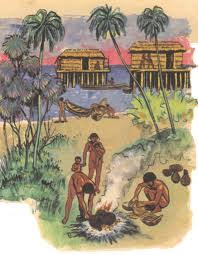
- The indigenous people of Venezuela
- .

- Venezuela's colonial period
- .

Was sighted by Christopher Columbus on his third voyage; he began a process of colonization, colonies and the last hundred years.
Characteristics related to the model agro-exporter:
The agro-export activity formed the basis around which was structured and consolidated the Venezuelan social formation; for more than four centuries, this activity represented the only source of significant surpluses, between crops, have exported cocoa and coffee among others; although linking the Venezuelan capitalist economy with those areas was commercial in nature.
Foreign capital operated through funding provided by foreign traders to producers and traders, through credit concepts developed for crops, but this was only significant foreign capital by way of government borrowing, reaching external debt to exaggerated levels.
Model agro-exporter:
· A unique key export (cocoa and coffee).
· Prices ranging as crises in the capitalist countries.
· Port economy (north-coastal development).
· Parasitic unproductive state.
· Manufactured goods are imported.
· Economic crisis both internal and external reasons (riots and lower prices).
· Insufficient capacity savings in the population.
- External debt occupies much of the budget.

 2.2 Model Crisis An
Exporter. Formation of A Dynamic and Modern Economy. Strengthening
The Rule As A Political and Economic.
2.2 Model Crisis An
Exporter. Formation of A Dynamic and Modern Economy. Strengthening
The Rule As A Political and Economic.
Model Crisis a Exporter: Import substitution has been, for almost all developing countries, the beginning of industrialization. Dependency ratios led to an international division of labor, whereby these countries exported unprocessed primary products in exchange for import of manufactured goods from industrialized countries. The most productive areas were closed while the international division persists production. The only way to develop a domestic industry was gradually displacing or replacing imported products. The deterioration in the terms of international trade and the inevitable expansion of the domestic market, thereby creating the possibility for internal economies of scale made the national capital and abroad be devoted to industrial production designed to meet the needs of the production domestic industry.
Venezuela is one of the poorest countries of Hispanic America with an agricultural export economy that tends to monoproduction with long periods of stagnation and continuous ups and downs. The trend is maintained when monoexportación coffee cultivation is predominant. The production and export of coffee is expanding rapidly since the mid-nineteenth century and becomes dominant with respect to cocoa, even though it is recovered in the last decades of the nineteenth century.
 Strengthening The Rule As A Political and Economic.
After the heroic years of independence, Venezuelans suffered under the corruption and brutality of caudillismo, fought a major civil war and saw the constant redrafting of the constitution and changes in the rules of the political game.
An oil-rich nation, by 1990 Venezuela enjoyed the highest annual per capita income in latin america and politically moderate labor movement.


2.3 The Social Structure and
Its Relation To The Productive Apparatus
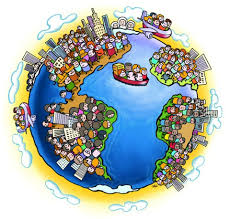
Venezuelan society has been formed in an uneven process, which responds, plus to traditional historical influences, as part of the spanish empire, and other derived is influence of the oil. In recent decades has increased the formation of big cities, but also have multiplied medium and small, as consequently elevation of growth demographic. The Venezuela oil company to concentrate its great resources in cities, and opened strengthened the dominance of urban, while which deepened the imbalances in the distribution of the population throughout the country. So far in Venezuela have not been achieved significant changes in the distribution geographic population. As the trend historic inhabitants to concentrate on coastal and mountainous strip has remained in the time until today.
Oil revenues have so far concealed the country's reality. Just like under previous administrations, the government led by Presindent Hugo Chavez has not taken advantage of oil revenues to expand the national industry.

2.4 Politics And State
Participation. Participation Of Monopolies
Political participation is the set of actions carried out by citizens who are not
necessarily involved in politics directly, and whose action is to influence the political process and the outcome. To understand the idea of political participation, it first has to introduce the concept of politics, which in this case could be described as the social mechanism for resolving conflicts between groups with different interests, where a greater degree of social complexity would result in number wholesale different interests. From this explanation, the political would be the individual charged with carrying out agreements between opposed interests in order to find a common solution to all of them, or failing that, find a way that they do not harm the order and the political system. The policy, therefore, is one that resolves conflicts by managing wills to achieve a common good for all. Political participation and citizen participation are related.
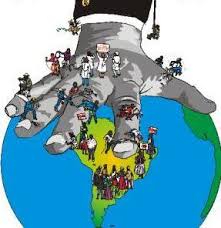
Monopolies are condemned by all. Has been shown in economic theory to bring losses to the equation being of society, but the law of competition may solve the problems of the Venezuelan economy?
The biggest problem is having monopoly control of prices outside of market mechanisms and the possible control of the supply of a particular good. Now, the shortage of home supply, inflation and currency devaluation does not due to existing monopolies. Indeed, monopolies and oligopolies, who still managed to survive the current socialist government regulation, are those who have sought a more efficient goods and services for the Venezuelan access. Moreover, the monopolist is the country's largest state. Leaving for a moment the economy, the state has a monopoly on justice, suspicion of violence, sanctions and the entry and exit of the borders and jurisdiction.
Alondra Vera I.C: 27.383.179
Fabiola Montilla I.C: 24.786.693



No hay comentarios:
Publicar un comentario